We don’t try to prove your strategy works. We try to break it.
A single backtest tells you what happened once, on one ordering of days, on data the strategy was built to fit. Strata treats every result as unproven and runs five kinds of test against it, all on your own machine.
Hold back data before anything is tested
A strategy tuned on six years of data will look brilliant on those six years. That is memory, not insight. So before a backtest or a search starts, Strata reserves the final part of your date range: 30% of sessions by default, rounded toward more holdout and kept in whole trading days.
Everything that chooses or tunes a strategy works on the training period only: the search, the ranking, parameter refinement, the optimizer and the walk-forward test. Inside training, the last 30% acts as an internal validation slice, so the search already has to generalize before the reserved period is touched.
Each completed candidate is then run once on the reserved dates with its settings fixed. Both periods must clear every mandatory check for a strategy to qualify, and a net loss on the reserved period caps the score at 34 no matter how good training looked.
Reshuffle the calendar
A backtest hands you one ordering of days, the historical one. Maximum drawdown is largely a property of that order, and order is partly luck.
The scored Monte Carlo test builds 2,000 alternative paths from the strategy's net daily P&L, including the days it did not trade. It samples five-session blocks with replacement, so short runs of good and bad days stay together the way they occurred. One-day and 20-day blocks are run as well, and the weakest of the three counts.
From those paths you get the share that stayed profitable, the 5th-percentile ending and the 95th-percentile drawdown: what the same trading could have looked like in a crueler sequence. If you trade a drawdown-limited account, that last number matters more than the historical one.
Make execution worse, and prices slightly wrong
Two full reruns raise the cost of trading: one extra tick of slippage with 50% more commission, then two ticks with double commission. These are complete simulations, not a flat amount subtracted at the end, because worse fills change which stops and limits are hit afterwards.
Eight more reruns nudge every open, high, low and close by up to one or two ticks and recompute everything: indicators, signals, fills. A strategy that only worked because price touched one exact level tends not to survive that.
Finally each numeric setting is moved to its neighbors, one at a time, up to twelve dimensions. A result worth keeping sits on a plateau of settings that also work, not on a single spike.
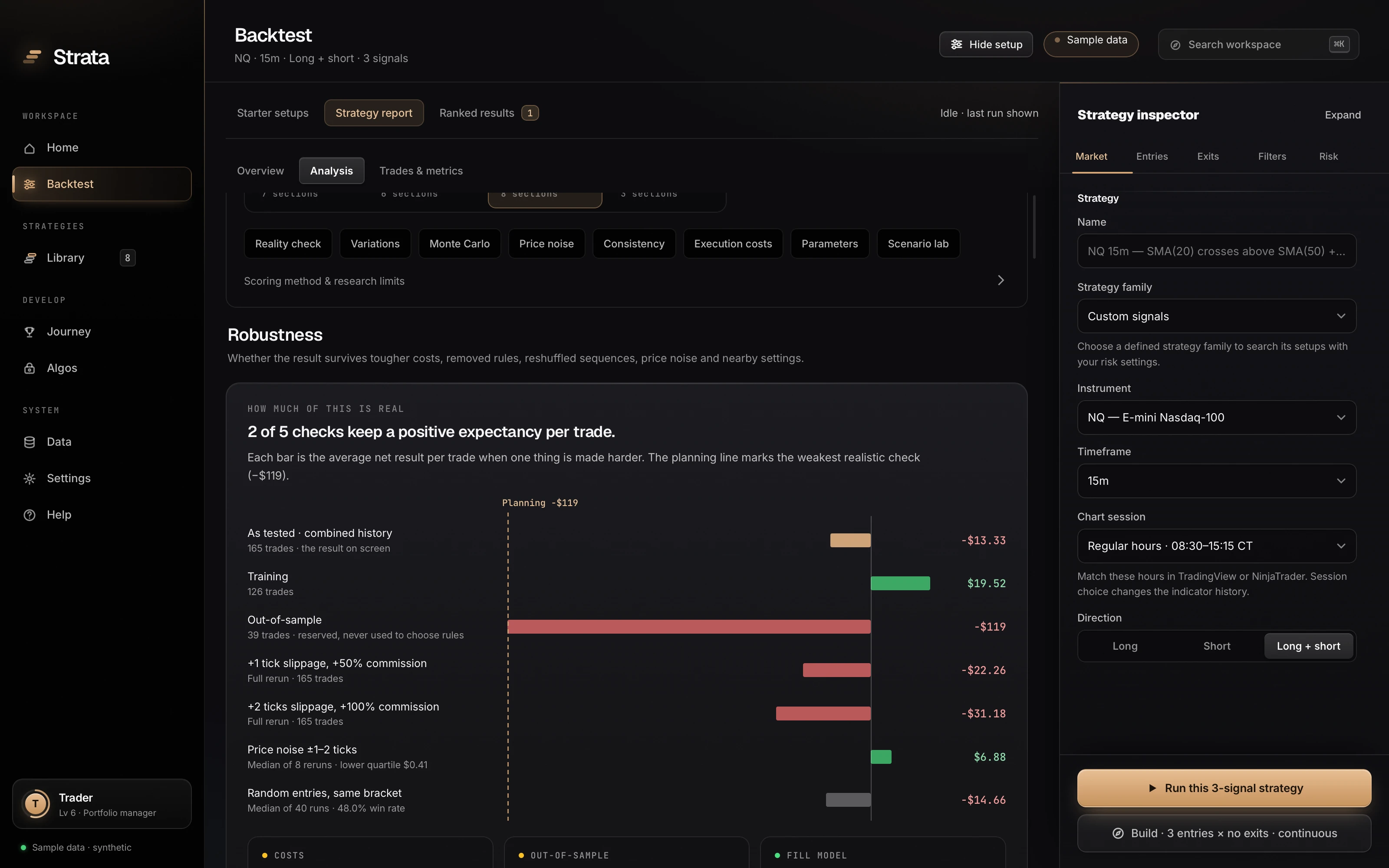
Expectancy per trade for one strategy as tested, on training, out of sample, under both cost stresses, under price noise and against random entries.
Ask how much the sample can support
A high Sharpe on 60 trades and the same Sharpe on 600 are different claims. Strata reports the lower bound of the Sharpe ratio, the probabilistic Sharpe ratio (the chance the true Sharpe is above zero given the sample's length, skew and fat tails) and the minimum track record needed to believe it.
Those feed the evidence factor in the Strata Score, together with the number of closed trades and the number of trades on the reserved period. Evidence multiplies the points a strategy earns above 50, so excellent-looking results on thin samples stay in the middle of the scale.
Account for the search itself
Test ten thousand combinations and the best one will look good by luck alone. Strata does three things about that.
The ranked board orders candidates by training score only, so the reserved period never picks a winner. The deflated Sharpe ratio raises the bar to the Sharpe that the best of N zero-edge strategies would reach by chance, where N is the number of candidates the search or the optimizer tried. And the board's overfitting check reruns the training leaders across 12,870 ways of splitting the training sessions in half, to measure how often the in-sample winner lands in the bottom half out of sample.
A versus-random baseline is shown as context too: the same exposure with randomized entries, on the same bars, through the same fill engine. It carries no weight in the score.
How a trade is filled
- Entry rules are evaluated when a bar closes, and eligible entries fill at the next bar's open. You see the signal, then you get the next print.
- Commission is charged per contract, per side. Slippage is charged in ticks against you on market fills. New strategies start at $2.50 per side for E-mini and full-size contracts and $0.75 for micros, with one tick of slippage; you set your own in Settings.
- Inside a bar, the engine walks a fixed path through open, high, low and close to decide which bracket order was hit. After an exit, the entry condition has to turn false before it can fire again, so a signal that stays true does not re-enter on every bar.
What we deliberately don’t model
A methodology page that only lists strengths is marketing. These are the limits:
- Order-book depth, queue position and partial fills. A bar-based backtest has no honest access to them, so Strata does not simulate a fiction of them.
- The true order of prices inside a bar. Open, high, low and close cannot prove whether the stop or the target was touched first. Strata uses a fixed, documented rule and flags trades that enter and exit on the same bar.
- Anything faster than one minute. The smallest bar is one minute. If your edge lives inside it, Strata is the wrong tool.
- Missing history. Bars before May 21, 2017 are flagged by the data vendor as incomplete. You can explore them, but a test that touches them cannot qualify, and missing minutes are never invented or filled forward.
- Other platforms' fills. TradingView and NinjaTrader have their own data and fill models. An export carries the same rules, not a promise of the same trades.
- The future. Every test on this page describes how a strategy behaved on history, reshuffled, stressed and held out in the ways above. None of it is a forecast.
All of the above rolls up into one number. How the Strata Score is built →
Futures and derivatives carry substantial risk. Backtest results do not guarantee future returns. Strata is software, not investment advice.